
A serendipitous occurrence in 2015 significantly aided in researching the Alex Fraser business and family story. Fraser Serendipity
Alexander “Alex” Fraser (1830-1903) – the surviving twin at his birth – m. Sarah Elizabeth Chamberlain (1835-1910), daughter of Hiram Wyman Chamberlain (1812- 1854) and Elizabeth Minerva Hayes (1816-1898). See CHAMBERLAIN entry. When Chamberlain unexpectedly died of cholera, the young son-in-law Alex took over the Chamberlain lumber merchant business. The youngest of Hugh’s sons, would go on to become a man of wealth and stature in colonial Canada.
As the youngest son of “Highland Hugh” Fraser, Alexander Fraser was a skilled businessman at an early age and became one of the few labelled TIMBER BARONS.
He would die in 1903 with an estate of nearly $4 million, approximately $146.9 million in today’s Canadian dollars, and his two sons, John Burns “JB ” and WHA “Willie,” went on to be prominent “LUMBER KINGS” with equally sizable estates. These Fraser men were kingpins in the Valley’s lumber industry and employers of many of the Westmeath Township’s men.


The Fraser family’s influence in and around the young Westmeath Township was strongly felt. Alex joined his father and brothers in lumbering and store-keeping. The Westmeath village store that his father Hugh Fraser had first built was replaced with a more modern building of lumber frame. His nephew Alexander “Red Alex” Fraser (1857-1936), son of his brother Thomas Fraser, partnered with John Paterson and they expanded the Fraser-Paterson General Store further. See PATERSON entry.
Alex founded the Fraser Lumber Company. His brother John was Woods Superintendent while Alex was Financial Manager. He became one of the Upper Ottawa Valley’s well-known timber barons using the wealth and knowledge of his father before him. During the peak of the lumber trade on both sides of the Ottawa River, many families owed their livelihood to the company. Winter shanty life in the lumber camps became the stuff of legend and song, throughout the Valley.
The paddle steamer “Alex Fraser” plied the waters of the Ottawa at Lower Allumette Lake for many years.


In the section on Lumbering in this website, read the details of Alex Fraser’s climb to the top of that industry. Timber Baron Alex Fraser, Arklan Farm & Fraser’s Landing.
In David Lee’s excellent Lumber Kings and Shantymen: Logging and Lumbering in the Ottawa Valley, the distinction is made between the “Timber Barons” who made their fortunes in the squared-timber trade and the “Lumber Kings” who in later years expanded the output of their sawmills and maintained high levels of lumber production. Lee asserts that: “Only 50 or so succeeded in building their forest operations to a scale where they could be considered barons or kings.” David Lee goes on:
Timber men were markedly conservative. Even those who had amassed enough money to invest in large scale lumbering preferred to stick with their first interest. For example, one well-known timber baron was Alexander Fraser, who sent rafts down the Ottawa River every years for nearly 50 years; despite his success in timber (he left an estate of three to four millions dollars), he never ventured into lumbering (though his sons did, on a minor scale).
The two properties north of Westmeath Village owned by Alex became the summer home for his family and also the working farm, “Arklan Farm”, supplying a number of jobs to area men.

Alexander Fraser’s long and very successful career as a well respected merchant and lumberman is outlined in the Obituary and Funeral Summations, 1903. Taken here from Ancestry.ca. Fraser, Alexander Obit & Funeral.

Lumber King JOHN BURNS FRASER carried on the lumber enterprises, becoming a powerful man.
Alexander Fraser (1830-1903) married Sarah Elizabeth Chamberlain (1835-1910) (see CHAMBERLAIN entry) and their six children are:
i. Emma Fraser (1857-1859) – died at 2 years.
ii. John Burns (J.B.) Fraser (1859-1939) m. Beatrice Bertha Curran (1860- 1933) in 1884 in Hamilton, ON. She was the daughter of Jonathan and Mary Curran. 1884 JB and Beatrice Marriage On the marriage reg. he is shown as working in Nipissing District. He gained a full working knowledge of the forests and the lumbering industry of eastern Ontario having gone into the his father’s business as a young man. 1933 Beatrice Curran Fraser Death

In the 1891 Census for Westmeath Township JB is listed as a merchant. He and his brother W.H.A. ran the Fraser Lumber Company. They also collaborated with Western Quebec lumberman George Bryson forming the Fraser-Bryson Lumber Company.


In the 1891 Census for Westmeath Township JB is listed as a merchant. He and his brother W.H.A. ran the Fraser Lumber Company. They also collaborated with Western Quebec lumberman George Bryson forming the Fraser-Bryson Lumber Company.


Ottawa Citizen JB Fraser Funeral -From Ancestry.ca.
1940 January 25, Estate of JB Fraser
1933 August 14, Estate of Beatrice Fraser.
1910 August 9, Ottawa Journal, House Fire


Children of JB and Beatrice Fraser are:

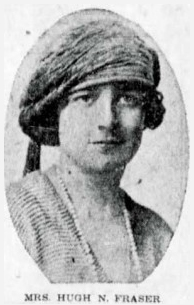
a. Hugh Neil Fraser (1885-1970), the eldest son would became a rancher in Okanagan Falls, British Columbia.

In 1914 he had joined the military and served overseas in World War 1. 1914 Hugh’s Attestation. He was interned in the Prisoner of War camp at Crefeld in German-occupied Denmark.
He initially thought he would not marry and thus would not inherit from his father’s estate.
Pittsburgh Post Gazette – 27 January 1940 – Gives Up Riches to Remain Single, Okanagan Falls, B.C. January 26, 1940 (Canadian Press)
Major Hugh N. Fraser, rancher and heir to nearly $1,500,000, prefers to remain single than marry to collect the money. He said today his father, John Burns Fraser, a former President of the Bank of Nova Scotia, who died November 2, left half his estate, valued at nearly $3,000,000, to Major Fraser, in trust until he married. If he dies a bachelor, his share goes to his brother, Lieutenant Colonel John D. Fraser, the other principal beneficiary. Mr. Fraser said he “will try and not marry” explaining he would receive the income from his share of the estate anyway.
At age 36, he married Lillian Phyllis Williams in 1922. 1922 Lillian & Hugh Marriage. No children. The marriage did not last, ending in divorce, and Phyllis remarried in 1927 to Percy Clarence Fauquier.



b. Lt. Col. John Donald “Jack” Fraser (1893-1970) m. Loretta Cecelia Dowling (1894- ) in 1916, the daughter of Dr. J.F. Dowling.

Jack Fraser was one of the hundreds of young men leaving for the Western Front in October of 1915. He was a member of the 8th Battalion, Canadian Mounted Rifles (CMR) on review by the Governor General on Parliament Hill, Ottawa. The Fraser Family Collection of photos includes a series taken of that event. 1915 8th Battalion, Canadian Mounted Rifles (CMR), Ottawa.

Following his military service in WW1, Jack took over the businesses started by his grandfather, father and uncle. Jack joined the Reserves and became a commanding officer of a militia regiment. He and his family enjoyed the society of Ottawa with his serving as the honorary Aide du Camp (ADC) to the then Governor General, Lord Tweedsmuir.


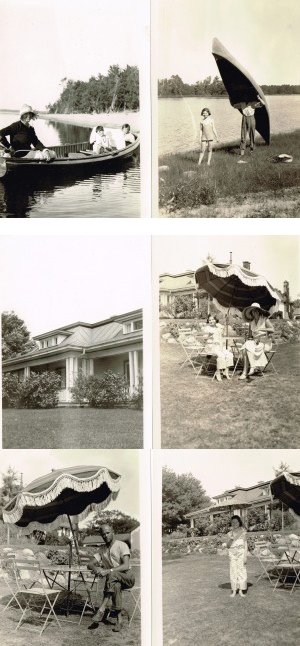
Jack, Loretta and the two girls enjoyed summers at Arklan Farm, Westmeath.
“Captain Fraser”, as the locals all called him, liked sports in general and took time to enjoy his timber limits, canoeing and hunting throughout the Fraser Lumbering Company holdings as his father, uncle and grandfather all had.
Malakoff Lodge, Fraser’s Landing
A new family summer camp was built by the Frasers, – much more rustic than the Arklan Farm summer house – situated upriver from Westmeath, north of Point Alexander and Deep River, located on the Quebec side, in Malakoff Township. That name was used also for their large log lodge and the family enjoyed their time at “Malakoff”, Fraser’s Landing, Sheenboro, Pontiac Regional County Municipality, QC,.


From “Some of the Stories I told You Were True” by Joan, Finnigan, as told by Jake Stewart, Pg.271.
“J.B. Fraser, the Pembroke lumbering millionaire used to have a game preserve and a big hunting lodge at Fraser’s Landing. All the millionaires used to come and spent the fall hunting with J.B. Fraser there. This fall there were four or five bank presidents, different banks, the Bank of Montreal and so on. One president had been over to Belgium and bought a gun over there, and when he was invited to Fraser’s he brought this gun and the bag and six boxes of cartridges and the gun cleaner and good leather case.
“They used to come up on the old “Weasel” (Oisaux), the old Brunson boat, at three o’clock and they’d have supper and clean their guns and get ready for the hunt in the morning. I always had some good hounds that would hunt anyway, and this Allan used to ask me the odd day to go over there and take my dogs. Now what they would do, the way they used to hunt, these millionaires would hire a man to row them up and down the river, So Mr. Allan came over this morning to me and he said “Well, will you come over Jake?”
“Yes. when do you want me?”
“Well not today. Tomorrow. How many dogs are you going to bring?”
And I said, “I’ll bring four or five.“
“Bring that good hound, the one that gives the loud tongue, because they love to hear that.”
I said, “All right.”
So next morning I went over, and old J.B. Fraser said to me “we pretty near had an accident last night.”
“What happened?”
“That bank president with the Belgium gun discharged it twice last night in the living room. I am going to drown it. Its a terrible dangerous gun.” At that time there was just the old pump guns, the old 3855 ad the old .44, and not too many of them either.
Fraser said “I made him put it up on the fireplace and I’m going to drown it when I go back.”
“Christ”, I said, “don’t drown it. Give it to me. I haven’t got a gun like that.“
No, he said, “Its very dangerous.”
“I think I’ll get around it alright“, I said.
That night when he came over he brought the gun – cartridges and everything. So I ran the hounds for the next few days and the bank president who owned the gun wouldn’t take anything for it. Nothing. But it just happened that I had an old dog Verdon, a helluva good dog. He picked up this big buck’s scent not too far from the cottages over there, and he run him around and he came into where I was coming out to the shore and I said, “That big buck will come here into the bay, sure as hell.” Sure enough, he came into the bay and the bank president shot the big buck from the rowboat. He was all tickled. The only buck left in Quebec.
That’s where these deer were all shot, in the river. They were run down to the river and shot. That’s what the boats were for. To pick them up. Illegal? Nothing was illegal then.”


The children of Jack and Loretta are:
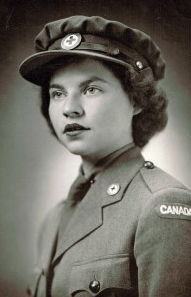
1. Joan Elizabeth Fraser (1918-1972) served in London during WW2 as a member of the Red Cross. Joan’s RedCrossService1939-45


2. Beatrice Bertha Fraser, known as “BeBe”, also took up Red Cross work and in the 1945 Voter List for Ottawa West, she with her parents and sister Joan, are living in Apt. 11 of the Roxborough Apartments in Ottawa. BeBe Fraser (1922- ) m. David Arthur Deziel (1915-1990) of Windsor in 1945. 1945 Bebe & David Marriage.He had been Missing in Action in 1942 and had a newspaper article written in his hometown of Windsor, ON. to that effect. 1942 Windsor Newspaper Capt. Deziel MIA.
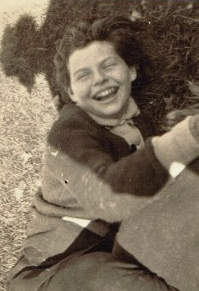
c. Beatrice Isabel Fraser Patridge Mitchell Bulmer of Florida had three husbands and lived her adult life in the USA. Beatrice Fraser m. (1) Donald Partridge of Montreal; two daughters: Gloria Partridge and Elizabeth Fraser Partridge.


Beatrice Partridge m. (2) Archibald Mitchell
Beatrice Mitchell m. (3)____ Bulmer.
Lumber King William Henry Alexander “WHA” Fraser carried on the lumber enterprises with his brother JB, becoming a powerful and respected man.
iv. William Henry Alexander (W.H.A.) Fraser (1863-1918) married Mary Anne Porter (1865- 1920). She was the daughter of James Porter and Eliza Bower. 1885 William & Mary Marriage.
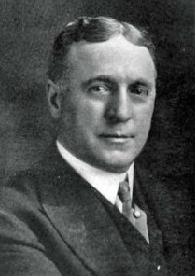
On their marriage registry of December 30, 1885, in Kemptville, Grenville County, Ontario, he is listed as a “lumber merchant” for the firm Alexander Fraser. The family spent their summers at the Frasers’ summer home, Arklan Farm, north of the Village of Westmeath, on Rapid Road and their winters in Ottawa, Ontario, with the children in private schools. However he would come to Arklan on lumbering business frequently during the winter season using the good rail links. Steam engine trains came to Beachburg & Pembroke and a train also ran up the Quebec side of the river to Waltham.
He was always known by his initials “WHA” to outsiders but within the family he was affectionately known as Willie.
WHA’s responsibilities with the lumbering business was to outfit the lumber camps – a massive job to source, purchase and transport all the required equipment and necessities for men and horses for the whole winter season.
A dedicated outdoorsman, he saw as much of the company’s holdings for himself as he could; often travelling into the lumber camps or onto the timber limits to assess them for himself. In person he could size up the worth of a man. And the worth of a stand of timber. His home base was at Westmeath and he knew all the farmers, teamsters and jobbers of the area.

WHA Fraser died of pernicious anemia – the inability to take up vitamin B12,- at the young age of 54 years. This is a draining condition causing fatigue and weakness in the sufferers. To a man who spent so much of his time in the bush crossing rough terrain to check the timber limits, this untreatable, (at that time), and therefore fatal disease, would be devastating.
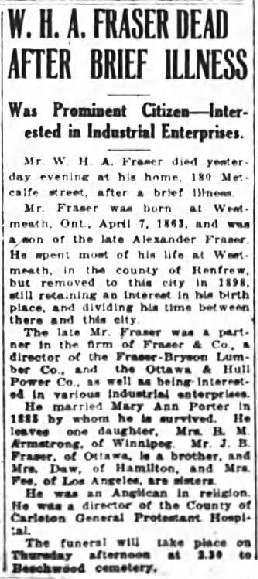
Pembroke Standard, February 7, 1918
THE PASSING OF W.H.A. FRASER — PROMINENT BUSINESS MAN — NATIVE OF WESTMEATH TOWNSHIP
Mr. W. H. A. Fraser died Monday evening at his home, 180 Metcalf street, Ottawa, after a brief illness.
Mr. Fraser was born at Westmeath, Ont., April 7, 1863 and was a son of the late Alexander Fraser. He spent most of his life at Westmeath, in the county of Renfrew but removed to Ottawa in 1898, still retaining his interest in his birth place, an dividing his time between there and the city.
The late Mr. Fraser was a partner in the firm of Fraser & Co., a director of Fraser-Bryson Lumber Co., and the Ottawa & Hull Power Co., as well as being interest in various industrial enterprises.
He married Mary Ann Porter in 1885 by whom he is survived. He leaves one daughter, Mrs. B. M. Armstrong, of Winnipeg. Mr. J. B. Fraser, of Ottawa, is a brother and Mrs. Daw of Hamilton and Mrs. Fee, of Los Angeles, are sisters.
He was an Anglican in religion. He was a director of the County of Carleton General Protestant Hospital.
The funeral takes places on Thursday afternoon at 2:30 to Beechwood cemetery.
Those in attendance at the Ottawa funeral from Westmeath were: Alex Fraser, Peter Ethier, Soloman Jones, J.R. Fraser, Mathew Barr and from Pembroke attending were:
E.A. Dunlop, MPP; J.G. Forgie, Foster Fraser. 1918 February 8, WHAFraser Funeral
In 1898 a horse thief, who was a former employee at the Fraser farm on Rapid Road, was sentenced to 3 years in Kingston Penitentiary. 1898 Fraser Horse Thief Sentenced.
In the 1901 Census for Westmeath Township the family is made up of: W.H.A. Fraser age 37; Mary A. Fraser age 35; two domestic servants: Elsie Leach and Tillie Burke and Fraser children:
1. Charlotte “Lottie” Ethel Marie Fraser (1886-1963) m. Bartle Mahon Armstrong (1878-1930). 1963 Charlotte Death Reg
2. Mildred Jessie Fraser (1889-1913) m. Brice Sheppard Evans. Child: Brice Evans. This grandchild would be taken into WHA and Mary’s household and raised there with provisions in WHA’s Will made for him.
3. Alexander Gordon Fraser (1890-1916). The family suffered a huge loss when at age 26, the only son was killed in action while, serving with the 21st Battalion, First Infantry Brigade. He died of wounds at the Battle of Courcelette (Battle of the Somme), and is buried at the British Military Cemetery at Puchevillers, France.
At 7 p.m. on the 15th of September, 1916, he went up with a party carrying ammunition and was to take command of Sunken Road Trench. When between Sunken Road and the Sugar Refinery a shell burst near him, wounding him in the head and several parts of the body. He was taken to No. 3 Casualty Clearing Station where he succumbed to the effect of his wounds on the 18th September, 1916. From Bower Genealogy.
4. James Porter Fraser (1891) – infant death.
Last Will and Testament of W.H.A. Fraser: William Henry Alexander Fraser died a very wealthy man, even by today’s standards. In his will, probated in Carleton County (Ottawa) in 1927, he generously provided for his brother John Burns Fraser, his wife Mary Ann Fraser, his daughter Lottie Ethel Marie Armstrong and his grandson Brice Evans, born to his predeceased daughter Mildred Jessie Evans. Brice Evans was only 4 months old at the time of his mother’s death and W.H.A. had custody of the child and maintained and supported him in the Ottawa Fraser home. He sets out full inheritance provision to this grandchild.
His sisters Caro F. Fee and Jessie Daw are also remembered in the will. Two non-family persons are mentioned in the will: a friend Miss Mary Hendrie Haslett of Hamilton and his “servant” Peter Hickey (Ethier) of Westmeath. Peter Hickey had worked for many years for Mr. Fraser and was held in high regard. See ETHIER entry. See Page 8, Item 19 in the 1918 Will.
In his lifetime Mr. Fraser and his wife had given funds to the Westmeath Methodist Church and other good causes and in his Will he bequeathed sums to Ottawa Hospitals.
Of note in the 1918 Will is the timely stipulation that:
“no portion of the assets shall be distributed or paid during the war to any beneficiary or creditor who is a German, Austro-Hungarian, Turkish or Bulgarian subject or other alien enemy wherever resident, or to any one on his behalf or to on behalf of any person resident in Germany, Austria-Hungary, Turkey or Bulgaria….”.
It was wartime and while the Great War raged in Europe, the British Empire and its Allies wanted to be assured no help would be given to its enemies. He had already paid heavily in the loss of his only son. To read the full Last Will of W.H.A. Fraser of Westmeath and Ottawa: W.H.A. Fraser’s Probated Will, 1918. For more on W.H.A. Fraser go to: http://bowergenealogy.ca/11/14922.htm.
v. Caroline “Caro” Fraser (1866-1949) m. J. Fee
vi. Martha “Madge” Fraser (1867-1904), in California, USA. She is commemorated on her parent’s tombstone at Beechwood Cemetery. Madge Fraser Obit
Further Notes on the Fraser Family
From History of the Lumber Industry in America:
Alexander Fraser Sr.
“Alexander Fraser, of Ottawa, one of the leaders of the square timber trade, was the son of Hugh Fraser, a Highlander who served in the War of 1812 and afterward settled at a point near Ottawa, where Alexander was born in 1830. He embarked in the lumbering industry and in 1853 took out his first raft of square timber on Black River. His career was successful from the start, and his operations rapidly increased until during the ’70’s he had frequently a dozen or so rafts simultaneously on the way to market. He was known from the headwaters of the Ottawa to Quebec. He was a man of great energy and determination of character, was possessed of a keen foresight and sound business judgment and often by tacit consent was accorded a leading part in the management of large enterprises in which he was interested. He was one of the founders of the Bank of Ottawa, the Lachine Rapids Hydraulic Company and the Ottawa Trust & Deposit Company and was also heavily interested in the Upper Ottawa Improvement Company and the Keewatin Lumber Company.
“Mr. Fraser sustained great reverses from time to time, but his strong financial standing enabled him to bear them easily. In 1895, upon his retirement from active business, his sons, J. B. and W. H. A. Fraser, organized the Fraser Lumber Company. Mr. Fraser died June 1, 1903, aged seventy-three years.”
“A steamboat tug named the Alex Fraser both moved passengers and towed timber on the Lower Allumette Lake for many years. The company also had a steamboat paddle-wheeler named the John Fraser operating on Lake Nipissing which suffered a fiery end.” http://www.pastforward.ca/perspectives/Jan_262001.htm
Editor’s Note: There is a discrepancy in the research. Below, Evelyn Moore Price names Alexander’s father as a Richard Fraser, a non-commissioned officer with the rank of Sergeant, while other writings name him as Hugh Fraser and a “Chief Gunner” in the artillery regiment, or Master Gunner, with the rank of Chief Warrant Officer. Still other writings give Hugh Fraser the rank of Major.
A strange incident occurred in 1892 when an inquiry was held into a possible hoax. 1892 Fraser Dynamiting Inquiry.
Alexander Fraser
by Evelyn Moore Price, The Pembroke Observer, Feb. 1983.
Alexander Fraser was one of the pioneer lumbermen of the Ottawa Valley born in Goulborn Township , Ontario, in July 1830, son of Mrs. and Mrs. Richard Fraser. His father was a non-commissioned officer in a highland regiment of the British Army. Early in the 19th Century they came to Canada with the sappers and miners who were brought out to work on the construction of the Rideau Canal.
“On severing his connection with the Armed Forces, Sgt. Fraser went up the Ottawa River as far as Pembroke, locating himself on land that later became a valuable and extensive farming property. As a boy Alexander Fraser grew to know the ways of the woodsmen, the ways of rivermen and in fact acquired knowledge of the lumbering industry, which being as it were a second part of his nature, contributed largely to his successful career as a lumberman.
“While still young he left the parental roof and was employed as a clerk in the general supply store of Hiram Chamberlain in the village of Pembroke. Being of a shrewd and canny businessman, at the age of 18 he was made manager. Later he married Miss. Sarah E. Chamberlain. Supplies were brought to Pembroke by Canoes in summer and by sleds in winter. Through his training he became thoroughly immersed in the many factors dealing with supplies for lumber camps, and in the business of bringing out logs and rafting them for transportation to Quebec City.
“Following the death of his father-in-law, Fraser continued to conduct the supply store with the same business acumen. Although only 24 years old, Quebec lumbermen had a profound respect for this shrewd young Scotsman. James Ross of Quebec one of the largest operating lumbermen, was ready to render financial aid to Fraser at any time, as he was trustworthy. In a short time Fraser was one of the powers in the lumbering industry on the Ottawa River.
“There was a steamboat, “The Alex Fraser”, sailed on the Lower Allumette Lake used for carrying passengers on certain days and also for towing logs on the Ottawa River. It was in service from 1891 to 1915 when it was dismantled and rebuilt at Quyon. In his later years, Fraser embarked on other enterprises such as the Lachine Power Co., the Ottawa Trusts and Deposits Co., and was greatly interested in the Hull and Aylmer Electric Railway.
“His sons John B. and W.H.A. Fraser assumed lumbering operation and management, forming the firm of Fraser & Co. and built a sawmill at Deschenes. His daughters were Mrs. J. Daw, wife of Rev. S. Daw, Mrs. J. Fee and Miss Madge Fraser. He was a Methodist and when in Ottawa was a member of the board of trustees of Dominion Church. He was a Conservative in polities. He was buried in Beechwood Cemetery, Ottawa, and many of the pallbearers were dignitaries and associates of the lumbering industry.
“Alex Sr.’s son W.H.A. Fraser, then in charge of the Fraser Lumber Company, knew the importance of retaining his skilled woodsmen the year round. He established Fraser’s Farm downstream from Westmeath, with homes provided for living quarters during the summer months. The men worked on Fraser’s Arkland Farm. The original six-sided building which housed the water system to supply running water to both the large summer home of the Frasers and the workmen’s homes, still stands on the east side of Rapid Road.”
Evelyn Moore Price’s 1984 book on the History of the Corporation of Westmeath Township, tells of a wild-west-style cattle drive, over the six miles route from the Village of Westmeath to the Waltham Ferry operating at Spotswoods, on the Ontario side of the Ottawa River. Cattle for the lumber camps of the Pontiac, in Western Quebec, were moved in this fashion. Cattle were purchased by buyers and moved on the hoof to the ferry where they were herded into a corral.
It was an exciting experience for Westmeath youths hired to ride herd on a drove of possibly 50 head, down the unfenced River Road, (now renamed Rapid Road), with dense bush on either side. Should an animal suddenly go berserk and head into the woods, it had to be followed – and if it could not be returned it had to be slaughtered.
Only eight cattle could go across on the ferry at one time so the hurdles of this cattle drive were numerous! It was the duty of the young herdsmen to guard against any animal leaping overboard during the ferry crossing and, if that happened, they were to get the animal back out of the river. Then after they were safely corralled at the Waltham side, they were driven up Black River to the lumber camps, to be butchered as needed; fresh beef to feed the hungry men. Before the age of refrigeration it was best to take them into the camps alive.